
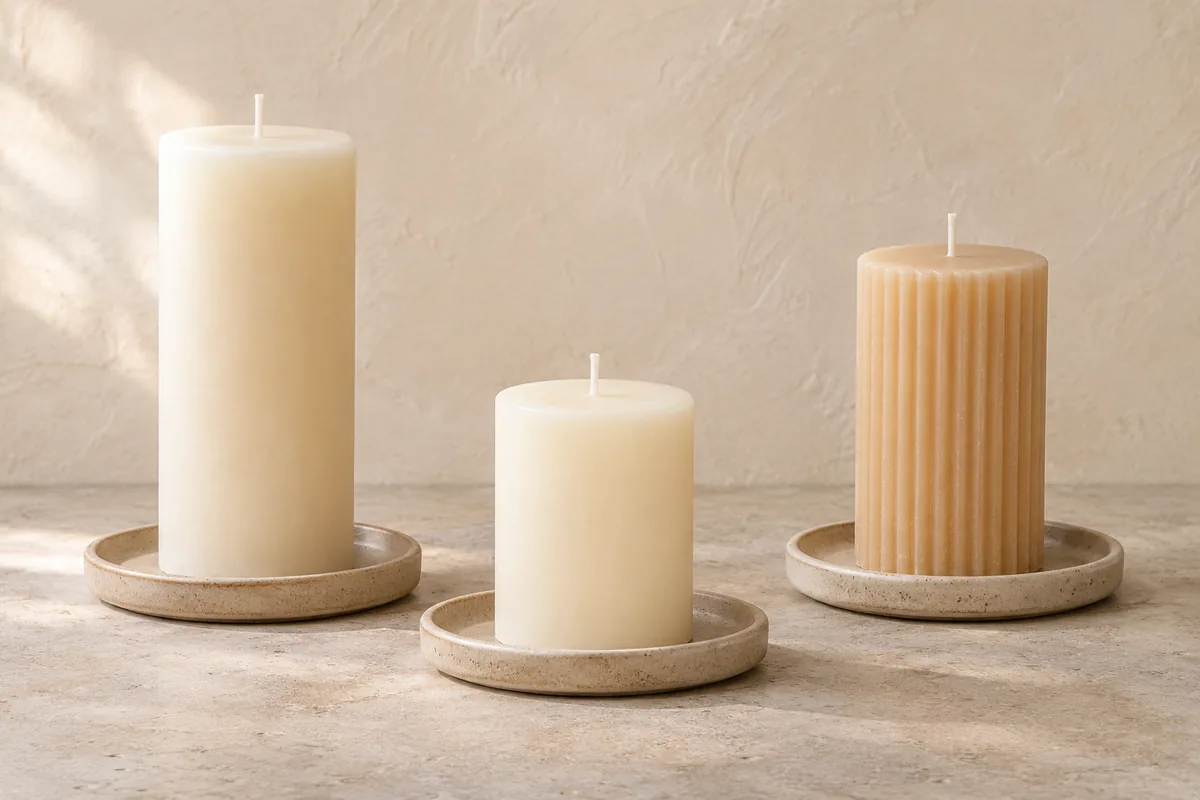
A pillar candle is a thick, freestanding wax candle that holds its shape without a jar. The answer to “what is a pillar candle?” also comes with a practical detail: although it stands on its own, it needs a suitable heat-resistant holder when lit.
| Feature | What it means |
|---|---|
| Structure | A self-supporting wax body with a broad, stable base |
| Shape | Usually a cylinder; square, ribbed, and sculptural designs are also available |
| Wax | Paraffin, beeswax, or a plant-based formulation suitable for pillars |
| Fragrance | Scented or unscented, depending on the product |
| Common uses | Ambient lighting, table displays, ceremonies, and unlit decoration |
| Holder | A stable, heat-resistant candle holder that accommodates the candle and catches drips |
| Burn time | Product-specific; check the maker’s total burn estimate and session limit |
What Makes a Pillar Candle Different?
A pillar candle supports its own wax body. A jar candle relies on its container to hold the wax, while a taper usually needs a fitted holder to stay upright.
Picture an ivory cylinder on a candle plate. The wax cylinder is the pillar; the plate gives it a stable place to burn and catches escaping wax.
In a product photo, a large jar candle can look much like a pillar. Check whether you’re looking at exposed wax or wax poured into a vessel.
- Pillar: A broad, freestanding candle used with a suitable heat-resistant holder when burning.
- Container candle: Wax poured into a vessel designed to contain it during use.
- Taper: A slender candle that typically fits into a candlestick.
- Votive: A small candle generally designed to melt inside a close-fitting votive holder.
- Tea light: A small, shallow candle supplied in a cup and used with an appropriate holder.
For decorative candles with curves or narrow sections, check whether the maker intends them for burning or display only. If you’re comparing formats for a brand, Iscent’s candle collection options show starting points for jar styles and branded presentation. Send a reference for a pillar design so its feasibility can be reviewed.
!An unlit pillar on a plate, a jar candle, a taper in a brass candlestick, and a votive in glass
From left: a pillar, a container candle, a taper, and a votive.
What Are Pillar Candles Made From?
Pillar candles use wax firm enough to hold a freestanding shape, with a wick matched to the formulation and candle size. “Soy,” “paraffin,” or “beeswax” tells you about the ingredients; burn performance also depends on how the finished candle is designed.
Paraffin and Beeswax
Paraffin and beeswax are both used to make pillar candles. Manufacturers select suitable wax grades or blends, then match the wick to the candle’s dimensions and other ingredients.
Paraffin pillars come in a wide range of colors and finishes. Beeswax pillars can have a naturally honey-like aroma, although color and scent vary with processing and the individual product.
A long wick, a draft, or an unsuitable setup can affect either type. The wax name alone won’t guarantee a drip-free or smoke-free burn.
Soy and Other Plant-Based Pillar Waxes
Plant-based pillars need a formulation intended for freestanding candles. A soft container wax is not automatically suitable for pouring into a pillar mold.
For example, CandleScience’s BW-921 product information identifies a soy-based wax made for pillars and lists a melting point of 135°F (57.2°C). That figure applies to BW-921. Other pillar waxes have their own specifications.
Look for clear burning instructions when buying a finished candle. If you’re making one, use a pillar-compatible wax and test the wax, wick, fragrance, and shape together before using the finished design.
How to Choose the Right Size and Burn Time
Choose a diameter and height that fit the place you’ll use the candle, then read its care instructions. A larger candle can hold more wax, but size alone won’t tell you how long it will burn.
A listing marked “3 × 6 inches” often means a 3-inch diameter and a 6-inch height. Confirm the order in the product description, especially for square or sculptural designs.
Measure the holder’s flat surface, too. A decorative rim can make a plate look wider than the area where the candle actually sits. For a business order, include those dimensions and your packaging needs in a custom candle brief.
Total Burn Time and Session Length Are Different
Total burn time estimates the candle’s useful life across multiple sessions. Session length is how long the maker allows you to burn it at one time.
Suppose a candle is rated for 60 hours with a three-hour session limit. The 60 hours would be spread across separate burns, each no longer than three hours.
When comparing burn times, look at candles with similar dimensions and wick counts, used under similar recommended conditions. A wide candle with several wicks may consume wax faster than a narrower candle with one wick.
Treat an advertised “up to” figure as an estimate. Drafts, wick care, and the way you use the candle can change the result.
Scented or Unscented?
Choose unscented pillars when you want candlelight without added fragrance, especially around food. Choose a scented version when fragrance is part of the experience you want.
“Pillar” describes the format, so either option can qualify. An unscented beeswax candle may still have its own mild natural aroma.
For a first purchase, I’d choose a simple shape with clear care instructions, then find a holder that fits. It’s easier to learn what a normal burn looks like when the shape is straightforward.
What Is a Pillar Candle Used for?
Pillar candles provide ambient light for dinners and ceremonies, and their exposed wax shapes work as unlit decoration. Decide whether you want to burn yours, display it, or do both before choosing a design.
Dining Tables and Gatherings
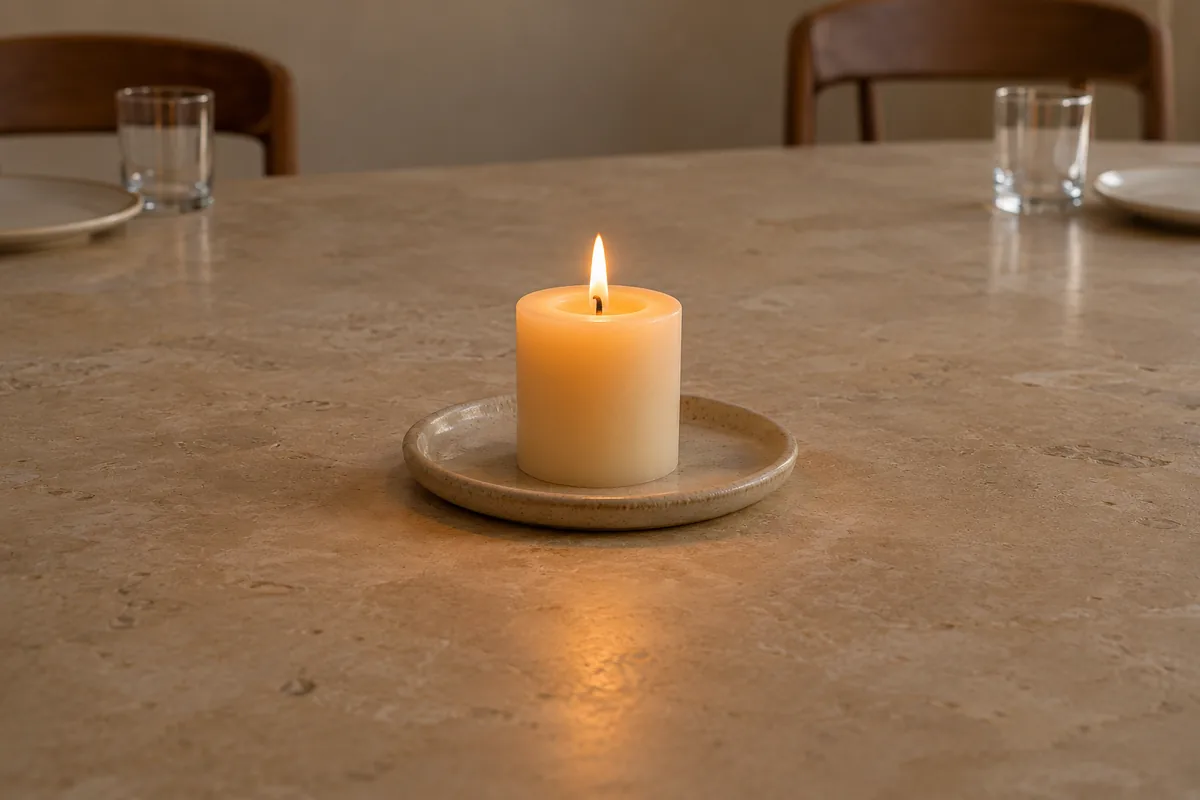
Unscented pillars can add soft light to a dining table without adding fragrance around the meal. Choose a height that lets people see and talk across the table comfortably.
For a small dinner, one pillar on a suitable candle plate may be enough. A larger table can accommodate several, provided each candle has safe spacing and a stable holder.
Keep napkins, menus, flowers, and sleeves clear of the flames. The U.S. Fire Administration recommends keeping candles at least 12 inches from anything that can burn.
Leave dried foliage well away from a lit candle, even if a tightly packed arrangement looks attractive in a photo.
Unlit Shelves, Consoles, and Mantels
Unlit pillar candles can add color, texture, and height to a shelf or console. Ribbed, twisted, or geometric shapes work as decorative objects without needing a flame.
A shelf beside books can work for an unlit display. Move the candle to a suitable open area before lighting it.
Use flameless pillars when you want the appearance of candlelight in a crowded display. Check their instructions for heat exposure and indoor or outdoor suitability.
Ceremonies and Events
Pillar candles can provide a focal point for weddings, memorials, and other ceremonies where candles are appropriate. Check the venue’s flame policy before buying them.
Some venues require approved enclosures; others allow only battery-operated candles. Check that any lantern meets both the venue’s rules and the candle maker’s requirements.
For power outages, choose a flashlight or battery lantern. The U.S. Fire Administration specifically recommends flashlights instead of candles for emergency lighting.
What Is a Pillar Candle Holder?
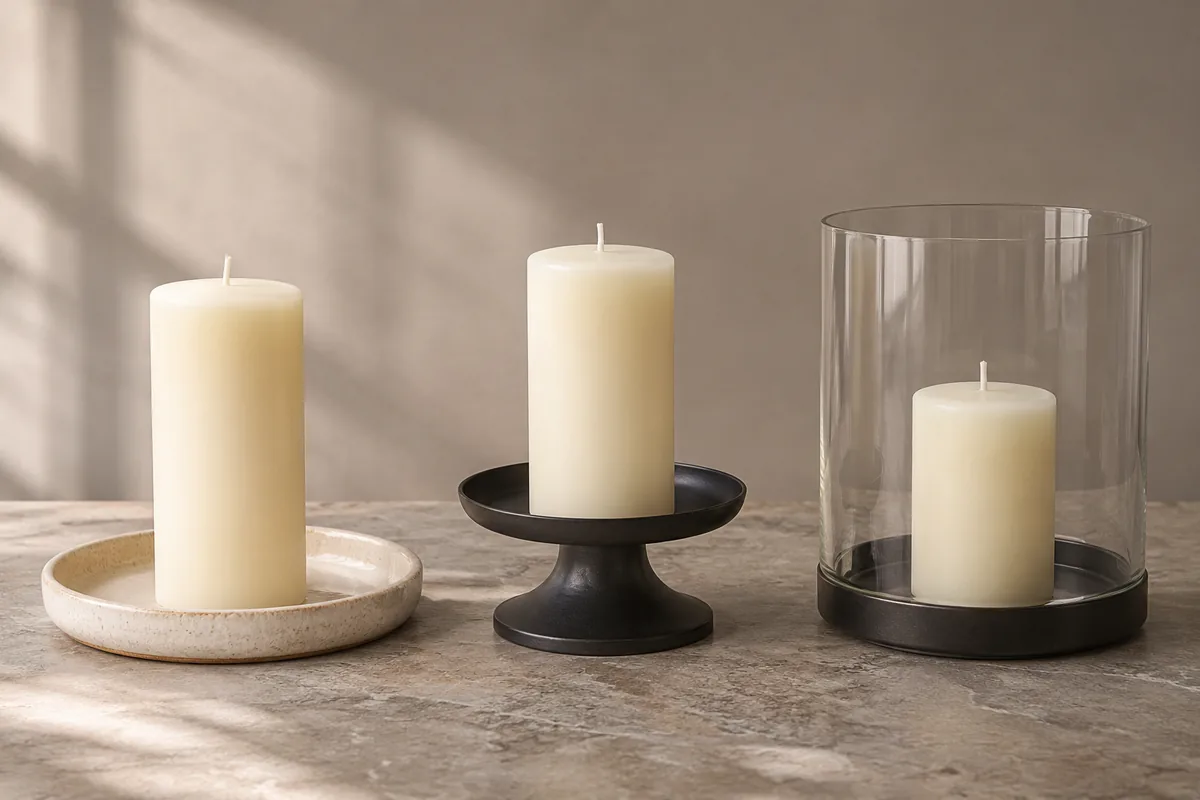
A pillar candle holder is a heat-resistant base or fixture designed to support a pillar during use and collect wax drips. Common versions include candle plates, pedestal holders, and purpose-made hurricane holders.
The broad wax base keeps the candle upright, but heat and escaping wax can still damage furniture. Use a suitable holder whenever you light it.
How to Pick a Holder That Fits
A suitable holder supports the entire candle base, remains stable under its weight, and has space to catch drips. Follow the holder’s stated candle-size limits.
Check these points before lighting:
- Set the candle on the flat part of the holder. It shouldn’t overhang an edge or rest on a decorative ridge.
- Check that the holder stays steady on a level surface, away from places where it could be knocked over.
- Confirm that it is intended for burning candles. A decorative tray may look suitable without being designed for heat.
- Look for a shape that catches escaping wax and keeps it off the furniture.
You’ll find purpose-made holders in metal, ceramic, and candle-safe glass. Check the intended use as well as the material: an ordinary drinking glass or decorative dish may not withstand candle heat.
When to Use a Hurricane Holder
A hurricane holder surrounds the candle with an enclosure, often glass, and needs the clearance and ventilation specified for that setup. A tight enclosure can change how heat builds up around the wax.
Read both sets of instructions. Fitting inside the glass is only one part of choosing a compatible candle and holder.
If the recommended dimensions or compatibility are unclear, choose a suitable open candle plate or ask the manufacturer before burning.
How to Burn a Pillar Candle Safely
Burn a pillar on a suitable holder and stay in the room while it is lit. Follow its care label alongside the general guidance from the National Candle Association and the U.S. Fire Administration.
1. Prepare the Candle and Its Location
Remove packaging and decorative accessories that are not intended to remain during burning. Set the candle upright on its holder, on a stable, heat-resistant surface.
Keep it away from drafts, children, pets, and anything combustible. Allow at least 12 inches from things that can burn, plus any greater clearance required by the product.
The National Candle Association also recommends at least three inches between multiple candles to help prevent them from melting one another. Follow a greater spacing requirement if the maker specifies one.
2. Trim the Wick Before Lighting
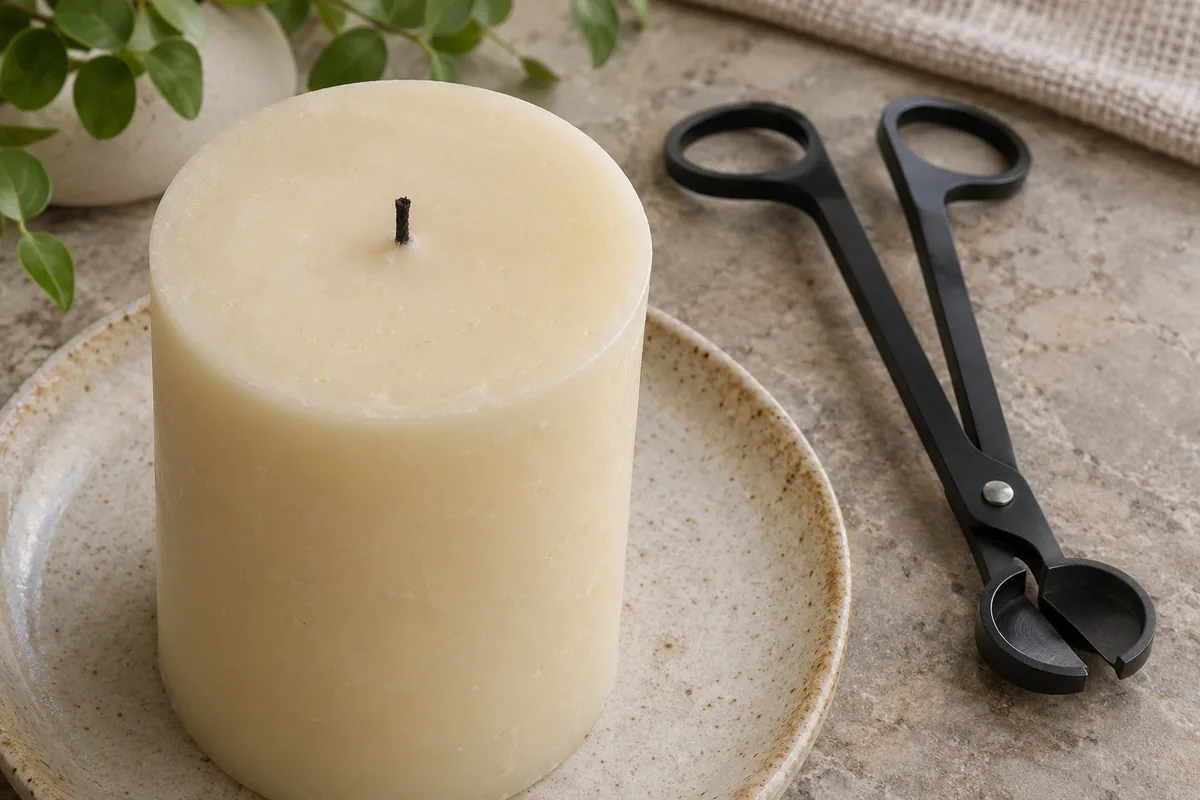
Trim the wick to the maker’s recommended length while the candle is cool. The National Candle Association gives a general guideline of ¼ inch.
Remove wick trimmings, matches, and other debris before lighting. Loose material can become an additional source of flame.
Leave a correctly trimmed wick alone. Cutting it too short can make the candle difficult to relight.
3. Follow the Candle’s First-Burn Instructions
Use the first-burn guidance supplied with your pillar. Many pillars are designed to retain an outer wax wall, so an edge-to-edge melt pool is not a universal goal.
The familiar “one hour per inch of diameter” rule depends on the product. It should never override the candle’s maximum session length or persuade you to keep burning a candle that is developing a problem.
A rim of wax can be normal. A deep, narrow cavity that makes the flame struggle is a better reason to check the candle’s care instructions.
Don’t keep extending the burn to melt away that rim. Stop if wax breaks through the side, the candle becomes unstable, or the flame behaves abnormally.
4. Watch the Flame and Respect the Session Limit
Stay nearby and extinguish the candle at its stated session limit, or sooner if it smokes persistently, flares, or leaks wax beyond the holder. Let it cool before investigating the cause.
Never move a lit candle or one containing liquid wax. Extinguish it before leaving the room or going to sleep.
The U.S. Fire Administration advises against using lit candles in bedrooms, bathrooms, and sleeping areas. Battery-operated pillars are a practical choice for those locations.
5. Extinguish and Let It Cool
Use a candle snuffer or gently blow out the flame, then check that the wick is fully extinguished. Don’t use water; the National Candle Association warns that it can splatter hot wax.
Wait until the candle and wax have cooled before touching or moving them. Retire it at the remaining-wax level specified by its maker, even if some wax is left.
Common Pillar Candle Problems and What to Do
Uneven burning, smoke, and dripping can result from the wick, the environment, or the candle’s design. Extinguish a misbehaving candle and let it cool before making adjustments.
- If wax runs down one side, check for drafts, an uneven surface, or an off-center wick. Confirm that the holder can contain the wax before using the candle again.
- For a tall or smoky flame, check the wick length and placement. Stop using the candle if the problem continues after you follow its care instructions.
- If a deep cavity develops, check whether the maker expects that burn pattern. Ask for advice before attempting a repair.
- Stop burning a leaning or cracked candle if it can no longer stand securely or contain its melt pool.
Skip improvised foil covers and aggressive reshaping unless the manufacturer provides a specific method for that candle. These changes can alter how heat builds up around the candle.
Questions to Check Before Buying
Before buying, check where you can use the candle, which holders fit, and how to care for it. For a branded range, Iscent’s private label candle service explains how available formats, fragrance, labels, and packaging are agreed before ordering.
Can You Put a Pillar Candle in a Jar?
Use an enclosure only when it is suitable for that particular candle. An ordinary jar has not necessarily been designed to hold a burning pillar.
Check the required clearance and ventilation. If the manufacturer advises against an enclosure, use a suitable open holder.
Are Pillar Candles Dripless?
Some resist dripping under specified conditions. Drafts, excessive heat, and wick problems can still cause drips, so don’t treat “dripless” as a guarantee.
Use a holder that can catch wax even when the product is described as drip-resistant.
Can You Leave a Pillar Candle Unlit?
Yes. You can keep a pillar as an unlit decoration for as long as you like if you store it under suitable conditions.
Keep it away from heat and direct sunlight that could soften or discolor the wax. Before eventually lighting it, inspect it for damage and check the care instructions again.
Planning a pillar candle collection?
Send Iscent Candles your reference design, dimensions, quantity, and scent preference, plus packaging needs, destination, and delivery date. We’ll review whether the design can be made and discuss a quotation. Our candle order minimum is 1,000 pieces; the proposed pillar design and order mix need confirmation.
Choose the Candle and Holder Together
For your first pillar, choose a stable shape and a compatible heat-resistant holder. Read the care instructions before buying, including the session limit, and pick a size and fragrance option that suit the space.
A sculptural candle can stay unlit on display; a suitable pillar can provide evening light while you’re there to watch it. The wax body stands on its own, and the holder provides a safe place to burn it.